

Which path fits?
Every path leads to the same result: structured transactions, accounts, and balances in Fyvel. They differ only in how the data arrives.
Recommendation for getting started
If your books are in DATEV and you want to try Fyvel first, GDPdU is usually the fastest path:- You do not need your own DATEV access. Not every company has DATEV Unternehmen Online enabled, and enabling it depends on the tax advisor.
- GDPdU is a standardised format. The export always contains the same set of files, so less can go wrong. With the account-ledger export, the wrong file often comes back: a PDF, the old view, a full-year view, or an export without creditor and debtor accounts.
- No setup required. DATEV Connect needs a technical activation. If that depends on your tax advisor, it takes several days. If you book yourself with DATEV SmartIT, Connect is usually usable within a day and is then a good choice from the start.
- You get the history immediately. One package covers a whole fiscal year, instead of month by month.
DATEV Unternehmen Online
You export the account-ledger view monthly as CSV and upload the files by drag and drop. The export must come from the German DATEV interface and include all accounts. This path works best when you have your own access to DATEV Unternehmen Online, because then you can control the report settings directly. Guide: DATEV Unternehmen OnlineDATEV GDPdU
You upload a complete fiscal year as a ZIP file. The package comes from DATEV Kanzlei-Rechnungswesen (GDPdU export, also called “Vorabprüfung”) and is usually provided by the tax advisor. Because the format is standardised, the request to the tax advisor is unambiguous and there is little room for the wrong export. A package always contains the whole fiscal year. How often you request a new one is up to you: once for the history, or regularly, for example monthly for ongoing reporting. Each upload replaces that fiscal year with the new state. Guide: DATEV GDPdUDATEV Connect
Fyvel pulls fiscal years directly through the DATEV Connect interface from the DATEV server where your books run, for example DATEV SmartIT or a server at your tax advisor. There is no manual export. A refresh always covers a whole fiscal year, but you start it with a button as often as you want, for example monthly. In day-to-day use this is the most convenient path. It requires a technical activation and an onboarding call. How long that takes depends on where your books live: as an in-house bookkeeper with DATEV SmartIT, activation is usually done within a day, sometimes immediately. If it goes through your tax advisor or an accounting-server provider, it usually takes several days. Guide: DATEV ConnectXero
In Xero you export the General Ledger Detail report as Excel and upload one file. The export must include all accounts, be ungrouped, and cover the full period you want to keep in Fyvel. Each new upload replaces the previous Xero state of that company. Guide: XeroOther sources
- Google Sheets sync — for individually configured setups: instead of the drag-and-drop area you see a sync button that imports data from the linked Google Sheet. The URL is stored in Company settings.
- We agree other individual integrations together during onboarding.
Set or change the import path
You choose the import path during onboarding. You cannot change it yourself afterwards. Write to [email protected] and we change the import path for your company in the backend. DATEV Connect also needs a technical setup, so we plan that switch together.The Uploads page
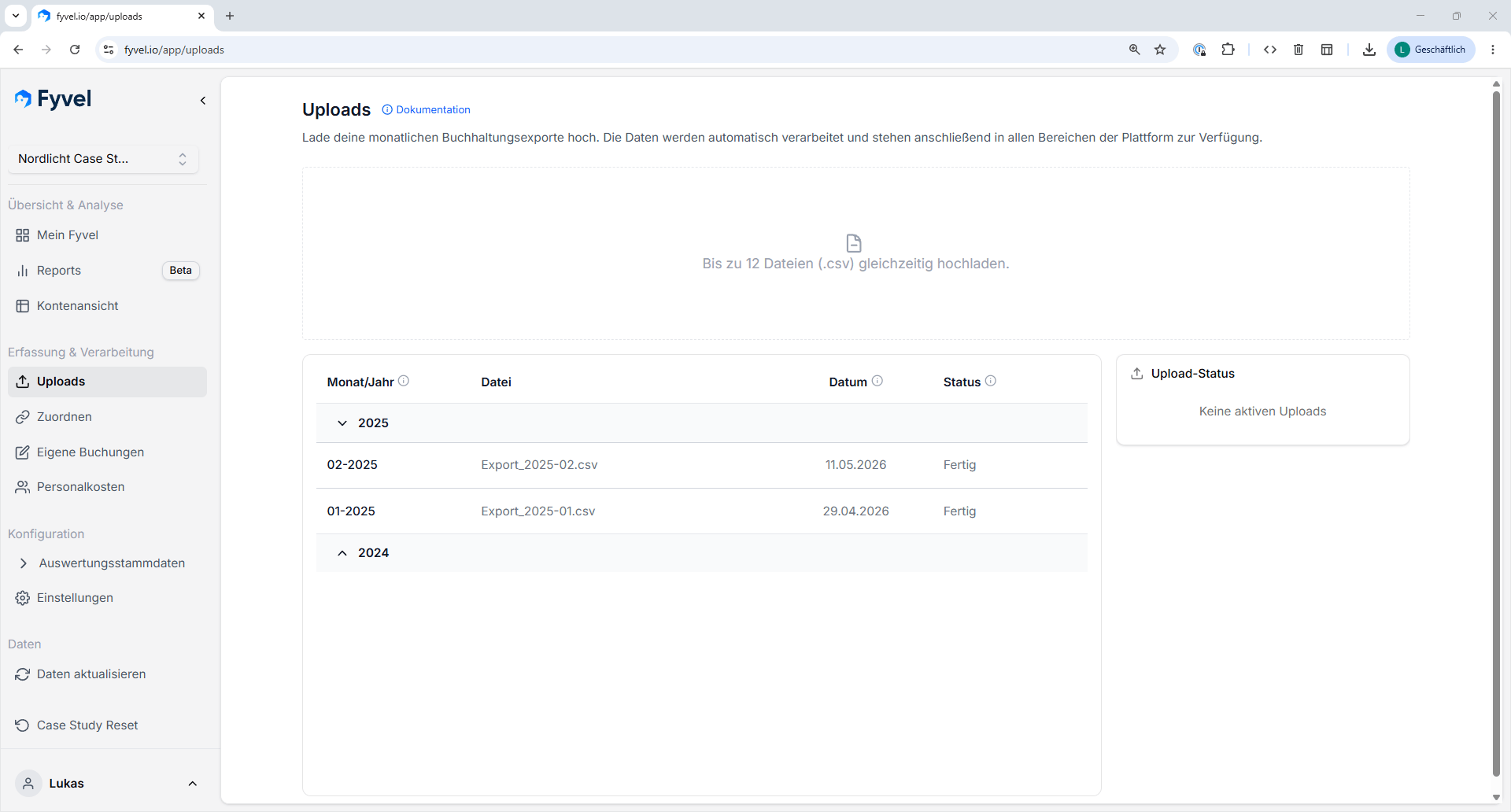
Uploads page with drag-and-drop area and upload table
This applies to every import path
- Fyvel detects automatically which bookings are new and which were already there. Existing mappings are kept.
- Upload regularly so your reporting stays current.
- Retrospective bookings are normal. It is worth importing periods you already imported again.
- Before larger imports, create a snapshot if you want to trace what changed (see Booking layers & snapshots). Fyvel reminds you at upload time.
- DATEV master data (client number, advisor number, chart of accounts, account number length) is used for validation during import. Check it in Company settings.